
1:04:27 PM
The Online Magazine FOR and ABOUT Southside Virginia
2/14/2026
|
Nov-Dec '09 Contents |
|
|
Nov-Dec '09 Cover
Articles
Fighter Flight Against Cancer
Fighter Flight Against Cancer
____ Special Section
Blessing of the Hounds
Blessing of the Hounds
Equestrian Academics
Ask Me One Question
Just Horsing Around
Horse Ads Explained
No Need To Explain
____ |
|
|
Columns
|
|
|
Departments
Farm & Ag Info Farmers Markets Listing
Festivals & Events
Press Releases VCE Master Gardener Course
SVHEC Launches New College for Life Long Learning
|
|
|
Past Issues
Past Issues are available from June 2008 through the current issue.
|
|
|
|
Shadows On The Roanoke
"Clarksville Then and Thener"
By Auntie Bellum
I think summer afternoons are most conducive to understanding the bewitching nature of the South. The heat shimmers, the cicadas sing, and the past flirts with you with coquettish eyes, as it peeks over the vapors on the hot, humid air. From childhood, this state has mesmerized me, and I have always felt the summer air held the key to opening the two-way door to experiencing the past.
It could just be that the summer was mine to enjoy. The last thing a kid of my generation wanted to do was spend the long days of school break inside. I grew up in the Victorian village of Hyattsville, Maryland, the land of Lord Calvert. His walled, gated home called Riverdale was only a mile or so from our house, and I would peer out the back window of our 1953 Ford and visualize the carriages that once clattered up the circular gravel drive of this grand tidewater estate.
From the Revolutionary war town of Bladensburg, with the Indian Queen Tavern that proudly proclaimed that �George Washington Slept Here�, to the dueling grounds that saw fifty duels over such things as the honor of a woman or the speed of a steamboat, the past pulled and tugged at my sleeve. The shimmering heat then, as now, drew me to earlier times and made me dream.

But my little piece of Colonial tidewater was cursed with a proximity to Washington, DC, and all too soon, the stigma of tract housing crushed and bulldozed the strata of memory that held these images. Progress broke the delicate bubble that contained the essence of time, and it became more and more difficult for me to slip into the twilight of the antebellum south that had been part of the balance and solace of my youth.
I first came to Clarksville in the fall of 1979. As we crossed the Roanoke and drove up the hill, I was met by the out-stretched arms of history, and I knew that I had come home. Clarksville was like a sweet remembrance of my lovely hometown and I nearly cried. The house we ultimately bought was a grand Victorian lady; the kind I always dreamed of living in, and that bubble that had cushioned and sustained me in my youth was around me once again.
The hot summer days here have given me much to muse upon. This old town has been part of three hundred and fifty years of European history, and centuries more in the annals of the Occoneechee. The crossing at Clarksville can be traced far back into those shadows. The commerce of many miles and hundreds of years has been funneled here due to the necessity of crossing the river. The Occoneechee Indians took advantage of this ambient spot and used Occoneechee Island as a toll booth. This very lucrative trade made them wealthy and unpopular. Both the Occoneechee Indians and the Roanoke River were known to be ill tempered, but if you wanted to cross, this was the safest place to do so.
For the history of Clarksville, we must start with William Royster. He first acquired land here in 1752. The ink in the deed book is 257 years old and can be forgiven for being illegible, so the actual acreage on the deed is at best guess sixty or eighty in total. All I can say for certain is that it ends in ty. His parcel was on the west side of the Roanoke and included what is now the town.
|
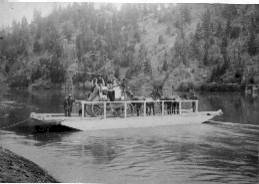
| Old Ferry Boat transporting horses and wagon.
US Forest Service Photo |
The next logical step was to provide lodgings and food for the customers of his ferry. We were still a remote outpost in the 1750�s. After a long day of travel and a worrisome trip over the river, a good tavern, or ordinary in the parlance of the day, would be a welcome stop on a journey. Royster�s Ordinary flourished, and was a focal point for the community. There are several pre-Revolutionary ads in the Virginia Gazette, which list the tavern. One was an advertisement for a horse that had been found, and could be seen at the tavern. The law of the time required that stray horses must be advertised. If not claimed within a prescribed period of time, the finder was allowed to keep the animal. Royster had accommodations for the horses and wagons that came with his visitors, so what better place to stable a lost horse in search of its owner? Another advertisement was for a plantation that was for sale in the vicinity. The ad asked that interested buyers stop at Royster�s for the exact directions to the property.
William�s tavern at the top of the hill was but one of many taverns that provided for the itinerant visitors in this town from the early days. As more people moved here, the roads improved and the lodgings and amenities grew proportionately. Two taverns still stand, at least two others that are listed in the histories, and from the volume of traffic at the ferries, and the continuing growth of the town, there were probably many more.

The fortunes of the Roysters increased steadily, and by 1792, when Clark Royster inherited his father�s empire, he was master of a great house, a tobacco warehouse, a tavern and tack shop, and probably much more. It was he who incorporated the town in 1818 on 100 acres of land.
The current town is nine streets by six streets in size, minus the majority of 2nd Street and all of 1st Street, which are under water. In 1818, the original plat shows the town running from the then rivers edge to 4th Street. The east to west thoroughfares were, as now, East Street, Commerce Street, Caroline Street, Market street and Virginia Avenue. Rose Hill was added at a later date. The Royster home is on Rose Hill, but was not on the initial town plat. The north to south streets were numbered one through four, with Independence Street running for two blocks north-south between Second and Third.
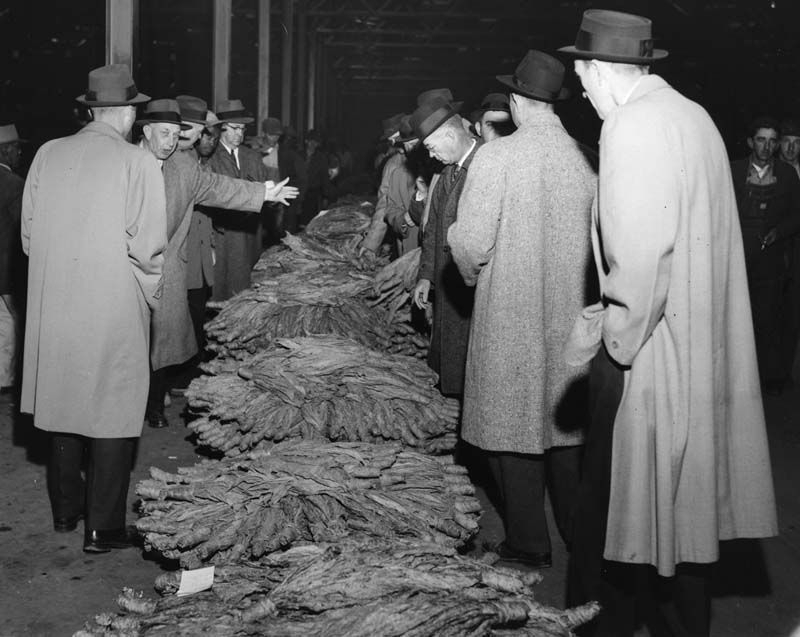
Royster�s Square occupied the corner where the Wachovia Bank now stands, and probably held Royster�s tobacco warehouse, which was established in 1818 when the town became an official tobacco inspection station. It remained the only one until 1833 when the Venable Warehouse was incorporated. They inspected and graded the hogsheads of tobacco for shipment out of the county. The tobacco commerce brought added prosperity to the town and region.
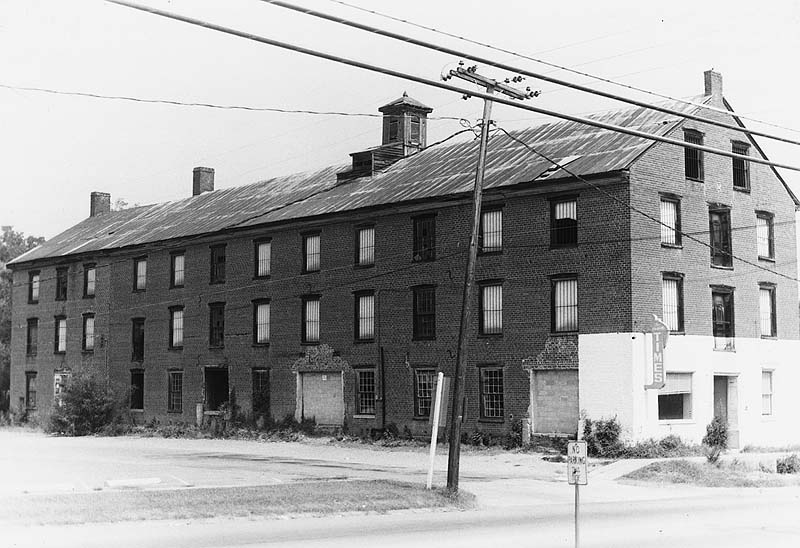
Mr. Moss opened his tobacco factory at the corner of 7th and Virginia Avenue in 1842.
|
| Moss Tobacco Factory, Mecklenburg County
National Register Nomination - Virginia Department of Historic Resources |
|
| Tobacco Auction Circa 1959
Photo - whtj tv |
A sure sign of growth was the establishment of the Exchange Bank of Virginia, which had branches in Richmond and Petersburg. This opened in 1838, and was followed by the Clarksville Savings Bank in 1847. The Civil War wrecked the banking industry as it did everything else, so banks and businesses have come and gone in the space of nearly two centuries. The oldest bank building in town is on Virginia Avenue and was built as part of the revitalization after the fire. The first newspaper in town was the Clarksville Herald published in 1846. There were earlier papers that covered the county, but this was the first one here, followed by The Tobacco Plant in 1853.
By 1835, the town had undergone some changes. Virginia Avenue had always been too steep a grade for the animals of 18th century commerce to handle. An alternate route a half block north had been the main business route to town for years. But around 1835, the town re-graded Virginia Avenue to make the grade less steep, and the other route was abandoned.
 A rock retainer wall was built up the main street before the Civil War, and is still visible in one place only. There is a white fence that spans a gap between the House of Prayer and Triple C Realty. Just beneath this fence the old wall is visible. Peep around the edge on the Triple C side for the best view, but be careful! It is a long way down to the bottom!
I don�t know when what is now 5th Street was officially added to the town, as it was not listed on the plan of 1818, but it was called Beauty Street at one point, and I think that really fits the amazing array of old houses that grace this particular road. Look carefully at the profiles of the buildings. They have all been updated according to their owner�s whims and the progressive styles of the times, but at the core you will find a good cross section of 19th Century Clarksville. Look beyond veneers of brick and siding, and listen to the houses. They will talk to an attentive ear and are proud of their position as elder statesmen.
In antediluvian times, 5th Street was the main road south. It dead ends now at the backside of the marina, but in the old days it connected with what is now Old Rock Road down on the peninsula that holds the mill village.
 Here, the road retaining an older name, The National Highway, travels past Burlington Industries and Merryfield Acres, where it is again interrupted by the lake. It used to continue through the now defunct town of Soudan to Highway 15 and then to the state line.
When they established the Historic District a few years back, their criteria was that houses must be at least 50 years old, and that pretty well took in the entire town. Pegged beams and granite stone blocks, either used as support for the house, or once used as the foundation for a cook�s chimney, are everywhere. As industries came in and brought viable payrolls to the townsfolk, newer homes were built and are interspersed with the old ones in the original core of the town. There is a walking tour available at town hall to identify the older homes, and some houses have signs that give an approximate age.
It is difficult to pin point exact dates on houses, as they were listed as �Appurtenances� in the old deeds. An appurtenance could be anything from a chicken coop to a large home with additional outbuildings.
 Wills are often helpful in dating houses, as the structures and names of the houses are listed in the inventories of the deceased, along with everything the person owned. You often find the number of cattle, the contents of the kitchen, and the number and names of slaves as part of the inventory. Construction methods, such as pegged beams, cut nails, or machine made hardware can narrow down the dates, and family histories are most helpful in the homes that have been in one or two families for their entirety.
The first settlers couldn�t afford fancy houses. The fact that they had a house at all was a sign of prosperity! In his diary of 1733, Col. William Byrd describes one man who was in the process of building his home, but it was a slow and expensive project. This fellow had gotten as far as three walls, but was lacking the fourth and a roof to surmount them. He and his wife and children happily lived in their three-cornered abode, weather permitting, but had to retreat to the fodder stack for shelter from the rain and cold!
The large houses tend to claim the spotlight with their grand porches and turrets, but pay some attention to the little houses. They were first!
 We have a wonderful collection of early houses here, usually one room stacked above another with a small rounded stair to the second story. As the fortunes and numbers of family members increased, a second identical building might be built, sometimes at right angles to the first, and connected by a hallway. Or they could be one story, two rooms, with a chimney either dead center, or on the ends. These bijoux homes were the stepping-stones to the fortunes that built the great houses two, sometimes three, generations later.
Clarksville was decimated by fire in the 1890�s. The bulk of lower Virginia Avenue is early 20th century and primarily brick construction because of this. The old commercial buildings sit with their hands on their stomachs and stare at the newer ones from underneath the eyebrows of arched pediments. The thirties brought in a new rash of buildings, such as the yellow brick one that started out as Davis Hardware. Note the glass awning with a touch of art deco. The Pizza Pub was the bus station, and retains the rounded porch around the side where one boarded the bus. The Town Hall was a movie theater. Note the distinctive deco-influenced architecture. Move around the corner on either side of this block, and you will encounter homes with feet firmly planted in the 18th Century. The church on east 4th Street is a treasure. There are two like it in the County, the other being in Boydton.
The trains that once offered passage from one end of the county to the other and beyond declined with the rise of the automobile. Antlers, Baskerville and Union Level were just as important as Boydton or Clarksville to the network that brought people and produce from one stop to the next.
 Montgomery Ward and Sears provided everything from corset stays to entire houses by train, and a crowd of wagons and buggies always anticipated the daily arrival of goods and passengers, and aided in their disbursement through the community. The passenger station was located on the waterfront, and was moved when the flooding began. The station can still be appreciated by enjoying a meal at the Clarksville Station restaurant in Roxboro, NC, where it was moved fifty years ago. Our solitary coal train rumbles its way to the CoGen plant, and is the only remnant of rail in the county. The tracks have been ripped up in most places, but the telltale line of the right of way is visible, and some of the stations have been adapted to other uses and are still in situ. Now we are interrupted by the rattling sounds of truck traffic as it speeds along the bypass, or the occasional eruption of motorcycles as they rev their engines in a flurry of speed. In Elizabethan times, kings were announced by the fanfares of Purcell and the splashing of oars. Modern day travelers are ushered in on car alarms and the whine of the hydroplane!
With the exception of LakeFest and the Christmas Parade, we tick along at the speed of Southside. For all that we have lost in time, we have gained a very important resource. Time itself. It�s important that we remember that the earth we tread has felt the imprint of moccasins and cart wheels. You don�t have to dig too deeply in your yard to recover an arrowhead or a cut nail from bygone years. We can all help by thinking twice before agreeing with someone who says, �What do you need with an old grist mill! What you need is a strip mall.� The proper answer is that there is room for both. A strip mall can be replaced by another strip mall and no one is the worse for the exchange. But when a house with pegged beams or a hand made mill are felled, not only have we lost the building itself, but the link to our past with it. Old and new coexist nicely, as 9 x 6 streets here already attest. Refurbish is better than rebuild, or move a structure to another place if demolition is the only other answer.
Colonial Williamsburg was the brainchild of a passionate clergyman who despaired of seeing the Colonial Capital being torn down for gas stations. We can follow this courageous man�s example and find ways of protecting our Colonial heritage. We have lost a great deal, but there is still so much left if only people take the time to notice and find a way to incorporate our wonderful, tangible city into the future This is an 18th century tobacco town. It is unique. We should be very proud of its history. We will be celebrating our bi-centennial in 2018, and I for one would like to see us celebrate our true heritage.
I am sitting here today, enjoying a tall glass of iced tea that is sweating onto my coaster. The cicadas are singing to the baton of an unseen conductor. I smell tobacco, as one should on such a day, and the affairs of today�s world are disappearing into the humidity. This is an ideal day for watching and listening to the shadows on the Roanoke.
Shadows on the Roanoke Part I | Shadows on the Roanoke Part II
PO Box 1061
South Boston, VA 24592
URL: http://www.discoversouthside.com
Copyright © 2008-11 Discover Southside
-