
6:06:22 PM
The Online Magazine FOR and ABOUT Southside Virginia
2/14/2026
|
In This Issue |
|
|
-=Issue Cover=-
Articles
Super Bowl Party with Kids
Grow Chives in Your Herb Garden
The Art of Norman Rockwell
Convergence Art Guild�s Film Odyssey
|
|
|
Columns Editor's Page
South Winds
Ask Bubba - Advice
|
|
|
Departments
Festivals & Events
Farm & Ag Info Annual Cotton Economics Meeting
Farmers Markets Listing
Press Releases Joani Layman selected as Master Gardener of the Year
|
|
|
Past Issues
Past Issues are available from June 2008 through the current issue.
|
|
|
|
Grow Chives in Your Herb Garden
(Herb of the Month)
Submitted by the Southside Virginia Herb Society
Chives, Allium schoenoprasum, are a great addition to the culinary garden that provides an
attractive year round plant with a remarkable effect on cooked foods. It is native to Asia and used for 5000 years.
Marco Polo introduced chives to Europe from the East.
 It was believed that bunches of dried chives hung around
a house would ward off disease and evil. The colonists brought chives with them to the New World.
Native American people in Alaska added the leaves to boiled fish for flavor. The leaves were used raw for
salads and cooked in soups and stews.
It was believed that bunches of dried chives hung around
a house would ward off disease and evil. The colonists brought chives with them to the New World.
Native American people in Alaska added the leaves to boiled fish for flavor. The leaves were used raw for
salads and cooked in soups and stews.
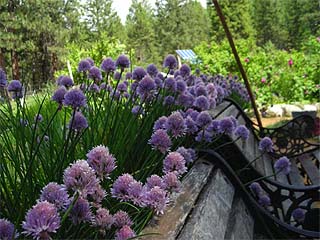
Chives are perennial bulbs in the Onion family. They are easy to grow. The plant forms narrow grassy tubular leaves and a regular cutting will keep them full and lush. Plants are hardy to Zone 3 so will do well in outdoor pots year round. They have a purple globular flower in late spring that repels most insects � it is a great companion to roses by keeping aphids away � and bees love it.
Chives are best grown from a clump of an established plant. They need a sunny or part shade,
well drained location. Cut back after flowering to encourage a fresh flush of leaves.
 Flowers not removed will
readily form seeds. The leaves generally persist through the winter in this area but a clump can be brought
indoors for easy reach. The bulbs do require a chilling dormant period so anything brought indoors will be
unlikely to survive past the winter. Divide every 3 years either in the spring or fall.
Flowers not removed will
readily form seeds. The leaves generally persist through the winter in this area but a clump can be brought
indoors for easy reach. The bulbs do require a chilling dormant period so anything brought indoors will be
unlikely to survive past the winter. Divide every 3 years either in the spring or fall.
Snipping the leaves can be done at any time after the plants are established. It is best to snip some of the clump down to about 2� rather than cut the entire crop. Best if used fresh but there is some success with freezing by washing and chopping the leaves and packing tightly into ice cube trays. Top with water and freeze. When frozen, remove the cubes from the trays, put in plastic bags and store in the freezer. To use, remove cubes as needed, thaw in a strainer and use as if fresh.
Chives have a flavor of sweet, mild onions. Generally the leaves are used but the flowers add a lovely, edible garnish to salads. As with many herbs, cooking chives will destroy the flavor. They are best used fresh or added at the last moment to cooked dishes. Chives are great chopped into scrambled eggs or omelets, mixed with sour cream to top baked potatoes, mixed with cream cheese as a spread for French Bread and chopped into tossed salads.
|
While it may seem that there isn�t much to do in the herb garden in February except drool over seed catalogs, now is a good time to get a soil sample from your herb garden plot to determine nutrient needs. In Virginia, your local extension office will provide instructions and a sample kit to be sent to Virginia Tech Soil Lab. When results are received, amend your beds as noted using organic amendments. These adhere to the soil particles making the nutrients more available to the plants when needed. It is also a good time to plant windowsill container gardens of dill or parsley and plant new roses outside.
The Southside Virginia Herb Society is a group of local enthusiasts interested in learning and sharing
knowledge of gardening, crafting and cooking with herbs. Members come from Halifax, Mecklenburg, Lunenburg and
Charlotte Counties.
For more information contact Kathy at 434-454-4208 or e-mail kathymmmg@hotmail.com.
PO Box 1061
South Boston, VA 24592
URL: http://www.discoversouthside.com
Copyright © 2008-11 Discover Southside
-